KUA News
February 2026 Newsletter
 Empowerment Through Opportunity
Our mission: to break down barriers for students by providing more instructional time, enriching programs and a high-expectations, no-excuses environment to ensure high school graduation, college success and career readiness are reasonable goals for all students regardless of race, language, ethnicity, gender, economic status or zip code.
Administrators’ message
Nearly 100 days into the school year, Kids Unlimited Academy is looking ahead to next year.
Kindergarten enrollment is open, as of Feb. 2. Current and prospective KUA families are invited to register incoming kinder students.
And spread the word among family members, friends and neighbors living in the Medford School District who have a child turning 5 years old by Sept. 1, 2026. Families who live outside the Medford School District also are welcome to apply at the KUA front office. Applicants must show proof of address and a birth certificate when registering.
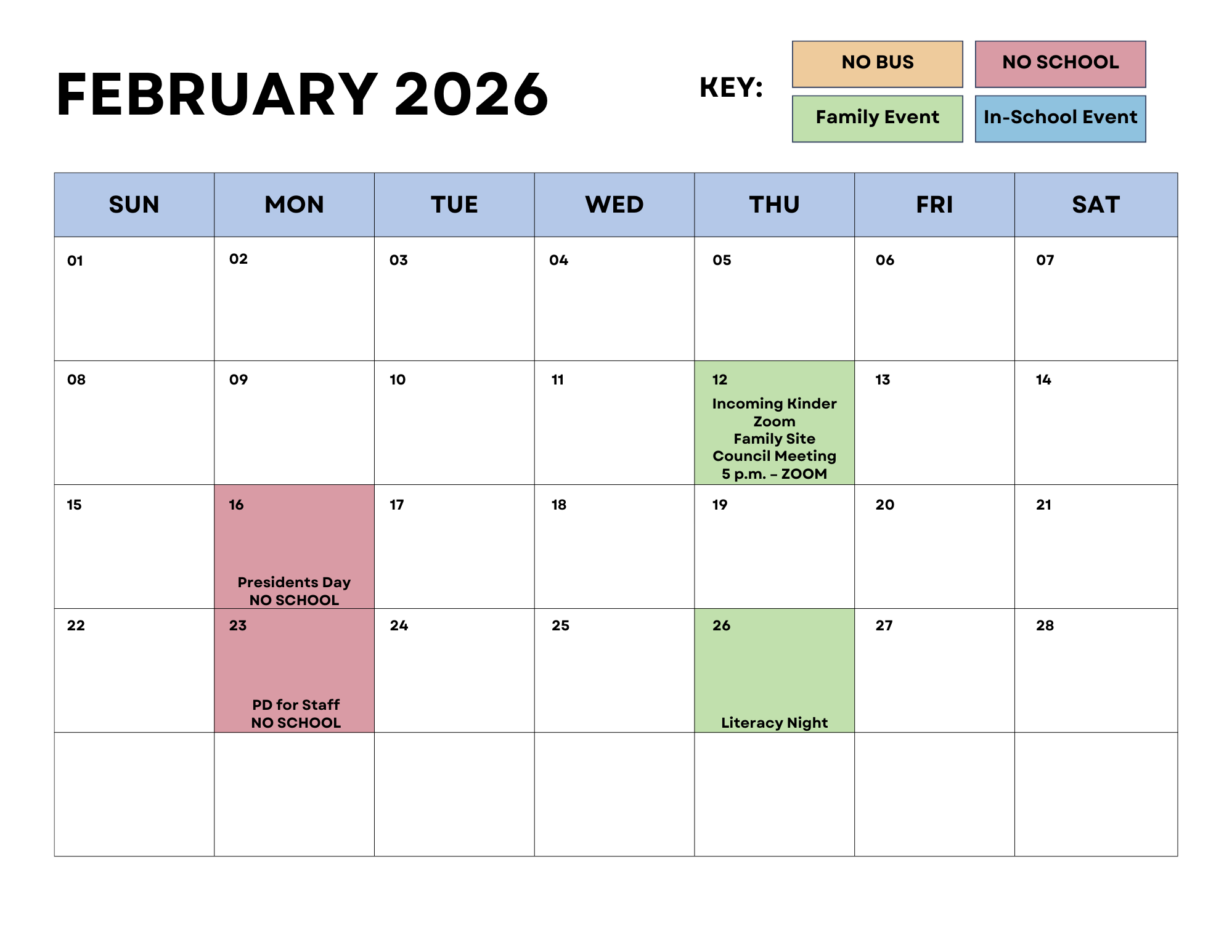
Questions about kindergarten will be answered during a 5 p.m. Zoom meeting Feb. 12 — KUA’s monthly Site Council. Current Pre-KU students and other students planning to attend KUA kindergarten next year can attend “Pre-K to Kinder” to hear more about what to expect. See the Zoom link on KUA’s Site Council page.
KUA marks its 100th day of school this month, when students will celebrate with some fun math- and centennial-themed activities. Check with individual classroom teachers about their themes for the day.
About 160 KUA students, or 35% of the student body, will undergo English Language Proficiency Assessment testing this month. ELPA results in students’ reading, writing, speaking and listening proficiency will be used to determine eligibility for English language development services.
Students’ literacy block for almost all grades begins each day by 8:10 a.m. Students who are tardy lose important learning and risk their reading development. In January, late drop-offs resulted in 901 unexcused tardies. Even a minute or two each day adds up during the course of the year to many minutes absent from school. If you or your family face barriers to arriving at school on time, please contact our front office or administrative staff for assistance.
Lupita Vargas – KU Director of Educational Services, lvargas@kuaoregon.org
Lindsay Ochs – KUA Principal, lindsay.ochs@kuaoregon.org
David Thygeson – KUA Assistant Principal, david.thygeson@kuaoregon.org
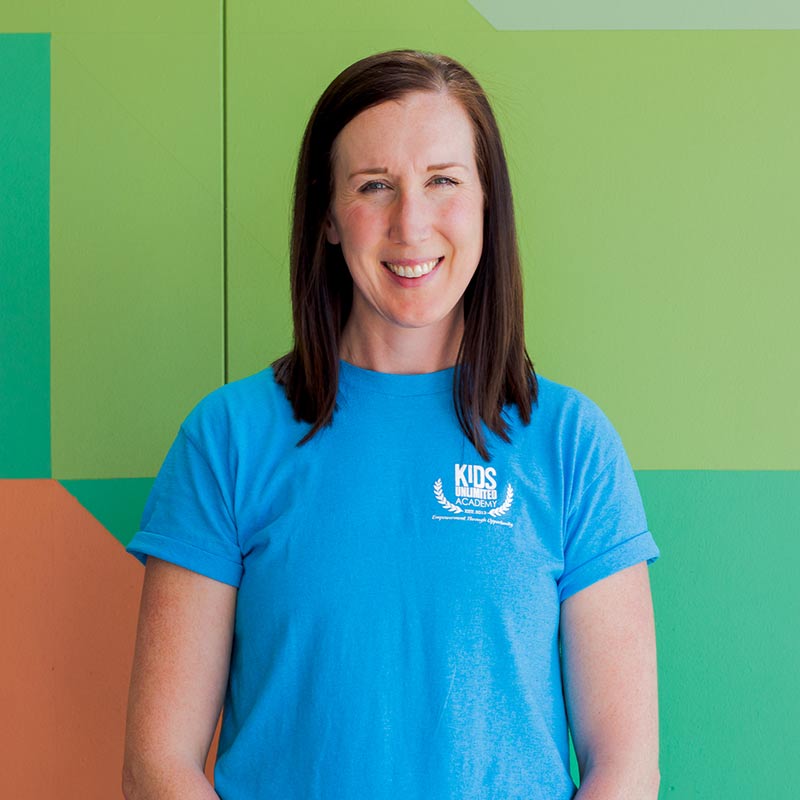
Lindsay Ochs
Principal
From the Principal’s desk
Literacy is a daily focus at Kids Unlimited Academy.
For the month of February, our charter school is elevating its commitment to literacy by inviting families to celebrate reading and the connections made through books.
Involving KUA’s new parent-teacher organization, Family Literacy Night is planned for Feb. 26, featuring activities, crafts, a book selected for each family and a keepsake “reading passport,” along with the opportunity for every family to apply for library cards. Dinner will be provided. Parents who can volunteer at the event, please contact PTO president Mayra Duran at GM.Duran@outlook.com
But don’t wait until the end of the month to make reading a daily focus in your family. This activity is the ideal way to decompress at the end of the day without interruptions from phones and other electronic devices.
Even 15 minutes spent reading together has significant development benefits for young children, in particular. Children who are read to daily at home are almost three times as likely to choose to read on their own compared with children who are read to just once a week, according to a recent survey by HarperCollins.
While we all tend to have favorite authors and genres, reading helps kids to accumulate a base of background knowledge, especially helpful when learning new material in school. Whether it’s geography, transportation, nature or countless other subjects, general understanding of our world and how things work gives students the confidence to tackle other topics.
When children are proficient in reading by the end of third grade, they are more likely to achieve higher educational outcomes, setting them up for success in careers, interpersonal interactions and other aspects of adulthood. That’s because literacy forms the foundation for ALL learning — students learn to think critically and communicate effectively. Seeking out credible information, asking questions, formulating one’s own responses and applying lessons to other disciplines are valuable, lifelong skills.
Aside from language and literacy, reading is an important mechanism for developing children’s empathy. “As kids read books about people whose lives are different from their own (and especially stories told from the perspectives of those people), they gain an appreciation for other people’s feelings, as well as other cultures, lifestyles and perspectives,” according to the Child Mind Institute.
The underlying message in many children’s books is learning how to handle feelings in healthy ways. When they encounter characters in books who experience big emotions, like anger or sadness, kids realize these feelings are normal. Such books often model for kids how to talk about their own difficult feelings, too.
The benefits of reading apply to any language (or languages). Among families who speak Spanish or other languages at home, kids and parents should feel empowered to read in the language most familiar to them without worrying they are discouraging English proficiency.
In situations when you can’t sit down with a book — riding in the car — simple word games build recognition of letter sounds. Play “I Spy” by referencing letters of the alphabet (“something that begins with “m”). Or choose a one-syllable word — “big,” for example — and ask kids to change just one sound in the word to make a new word (“dig,” “bib,” “bag,” etc.). For kids who really get the hang of this, “keep score” of how many new words they can make.
This simple technique is upheld by the “science of reading,” the basis for KUA’s English language arts curriculum. Such exercises help kids to understand the mechanics of language, rather than relying on their memories of words.
But even if kids want to read a book so many times they can recite it from memory, rest assured that repetition is a component of mastering language. If your family needs any assistance with acquiring books for your household, please reach out to your student’s classroom teacher or KUA’s administration.
Happy reading!
Attendance matters!

Regular school attendance promotes school success and is required by Oregon Law, which mandates that students miss no more than 15 school days each academic year. Any student absent for 10 or more consecutive days will be dropped from KUA enrollment. Your child may lose his/her spot at KUA.
The loss of learning that takes place when your child is absent cannot be replaced. Chronic absenteeism in kindergarten can predict lower test scores, poor attendance and retention in later grades. If you need help getting your child to school on time, please reach out to us!
Always notify the school, by calling the office at 541-774-3900 between 7:30 a.m. and 9 a.m., when your child is absent or going to be absent for any reason. Please provide the student’s full name, grade and reason for absence. A doctor’s note is required for absences of longer than 3 days.
Attendance matters!
Regular school attendance promotes school success and is required by Oregon Law, which mandates that students miss no more than 15 school days each academic year. Any student absent for 10 or more consecutive days will be dropped from KUA enrollment. Your child may lose his/her spot at KUA.
The loss of learning that takes place when your child is absent cannot be replaced. Chronic absenteeism in kindergarten can predict lower test scores, poor attendance and retention in later grades. If you need help getting your child to school on time, please reach out to us!
Always notify the school, by calling the office at 541-774-3900 between 7:30 a.m. and 9 a.m., when your child is absent or going to be absent for any reason. Please provide the student’s full name, grade and reason for absence. A doctor’s note is required for absences of longer than 3 days.
Why year-round school?
We can’t speak highly enough of our year-round academic calendar, which is overwhelmingly supported by our families. Below are a few key reasons why we decided in 2021 to become Oregon’s first year-round public school.
- Students retain what they learn all year, rather than experience summer learning loss.
- Additional time for authentic hands-on learning opportunities, excursions and field trips.
- Additional school days help to close the achievement gap.
- Increased opportunities for extra help and tutoring.
- Consistent routines lead to better-adjusted students — and teachers
- Easier access for vacations during the school year.
- Decreased teacher and student absences.

What’s cooking?
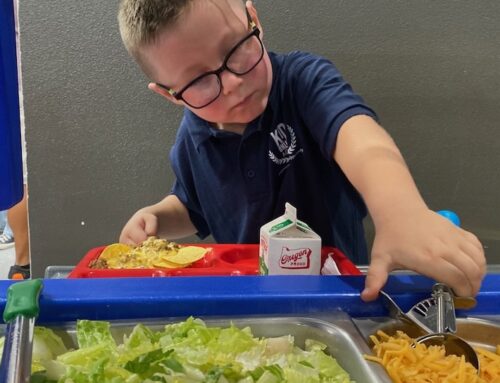
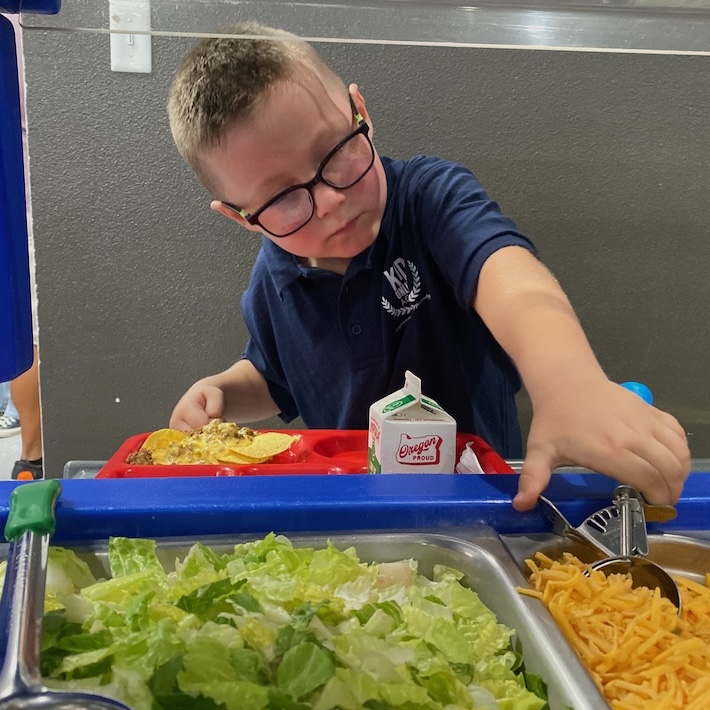
Our new Food Program puts more variety on students’ plates.
Breakfast, lunch and dinner menus incorporate more locally produced ingredients, including seasonally fresh fruits and vegetables. Beef and veggie Stroganoff and chicken, sausage and veggie jambalaya are new recipes to complement favorites like carnitas tacos and green pozole. Check out the menu at kuaoregon.org/menu
All KUA students are eligible for free breakfast, lunch and dinner — cooked from scratch using fresh ingredients in our on-site kitchen. We are an equal opportunity provider and employer.
Our nationally recognized, award-winning food program is unique in the Medford school district, and we take pride in providing students’ daily nutrition. Build your kids’ healthy habits at home with whole foods instead of processed ones.
February is American Heart Month, a nationwide campaign to raise awareness of cardiovascular disease. Protect your family’s heart health by putting more plant-based meals and fish on the table. Salmon’s omega-3 fatty acids are an important nutrient for healthy cholesterol and blood pressure levels.
Canned salmon is an easy and affordable pantry staple that can be made into patties, incorporated in salads and stirred into pasta dishes and casseroles, like this one. Canned tuna also could be used.
Find more family-friendly recipes at cookingmatters.org
Salmon Pasta Bake

Ingredients:
- 2 cups whole wheat penne pasta
- 2 medium scallions
- 1 (14.5-ounce) can pink salmon in water
- 1 cup frozen peas
- 1 cup nonfat or low-fat plain yogurt
- 2 teaspoons dried dill or dried parsley or 2 tablespoons fresh herbs
- 1/4 teaspoon salt
- 1/4 teaspoon ground black pepper
- 1/2 cup Parmesan cheese, grated
Instructions:
- Preheat oven to 400 F.
- Boil the pasta in salted water according to package directions. Drain in a colander. Run under water until cool to the touch, to keep noodles from sticking together.
- Rinse, trim and finely chop the scallions.
- Drain the canned salmon. In a large bowl, mix salmon and drained pasta with the peas, yogurt, dill or parsley, scallions, salt and black pepper.
- Transfer pasta mixture to a 9-inch square baking dish.
- Sprinkle the Parmesan cheese over pasta mixture. Bake in preheated oven for 25-30 minutes, until bubbling and golden.
Makes 9 servings.
Table Talk
 Family conversations during meals or before bedtime are a great way to reconnect, help younger kids to develop language skills and help parents to stay informed about happenings at school.
If kids are reluctant to talk about events of the day out loud, encourage them to explore their feelings by drawing or — for older kids — writing some thoughts on paper. Use the Table Talk flyer sent home with students as a guide and return it to the front office for credit toward fulfilling monthly volunteer hours.
“What makes you feel loved or cared for?”
“How do you show kindness toward others?”
“What’s your favorite sweet treat?”
The Month Ahead